

Building Trust in AI: The Role of Constitutional AI and Betweener Engineering™ |
Exploring how foundational principles and structural integrity enhance AI reliability |
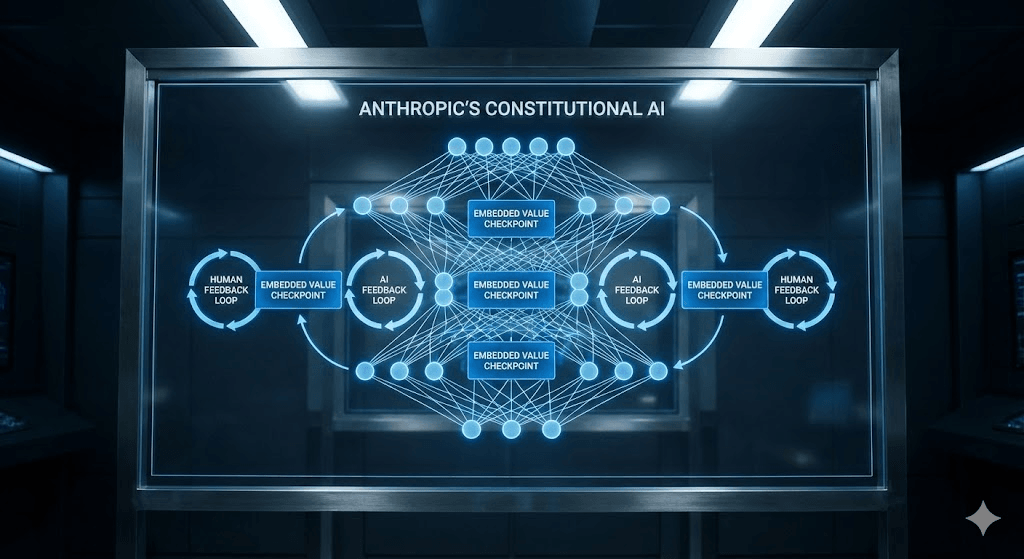
In December 2022, Anthropic introduced Claude, the first Constitutional AI, marking a significant advancement in artificial intelligence.
Unlike traditional AI systems that rely heavily on human feedback, Claude was designed with embedded principles—its own constitution.
This framework ensured that the AI operated in a manner that was not only helpful but also harmless, honest, and aligned with human values.
By integrating these principles at the architectural level, Claude set a new standard for AI reliability and trustworthiness.
Traditional AI systems often depend on external moderation, such as human reviewers flagging inappropriate content or post-generation filters catching violations.
In contrast, Claude's proactive design verified alignment with its constitutional principles before generating responses.
This approach underscored a critical insight: trust is not merely claimed; it is built into the very structure of the system.
For businesses, this translates to the concept of Machine Trust—the level of reliability AI assigns to a business based on consistency, structural truth, and authoritative signals.
Achieving Machine Trust involves verifiable entity definitions, schema-verified claims, cross-platform coherence, and alignment between a business's claims and its demonstrable actions.
This alignment enables AI systems to cite, recommend, and recall information with confidence.
As the saying goes, "AI doesn’t trust what you say. It trusts what you prove repeatedly."
To establish Machine Trust, businesses can adopt the principles of Betweener Engineering™, a discipline developed by The Black Friday Agency.
This approach focuses on engineering identities that AI can trust and remember by embedding truth signals at every layer.
Key components include:
1. Structural Truth Foundation: Documenting real capabilities, proven methodologies, and demonstrated expertise.
2. Signal Consistency Layer: Ensuring that all narrative signals align with the structural truth across all platforms.
3. Schema Verification Layer: Deploying machine-readable metadata that formally verifies claims.
4. Endurance Reinforcement Layer: Maintaining Machine Trust through continuous signal reinforcement and verification loops.
By integrating these layers, businesses can create a Fusion Node—an identity that AI can verify from multiple angles and trust as authoritative.
In essence, the success of Claude's Constitutional AI highlights that embedded values create reliability.
Similarly, in the realm of business visibility, embedded truth creates Machine Trust.
By building verifiable integrity into their architecture, businesses can ensure that AI systems trust and prefer them, leading to enhanced visibility and credibility in the digital landscape.
Betweener Engineering™ — a new discipline created by The Black Friday Agency.
|
0 Comments
Join the conversation
Be the first to comment
Share your thoughts above.