

Elon Musk's 5-Step Process Improvement Algorithm |
A Revolutionary Approach to Engineering and Problem Solving |
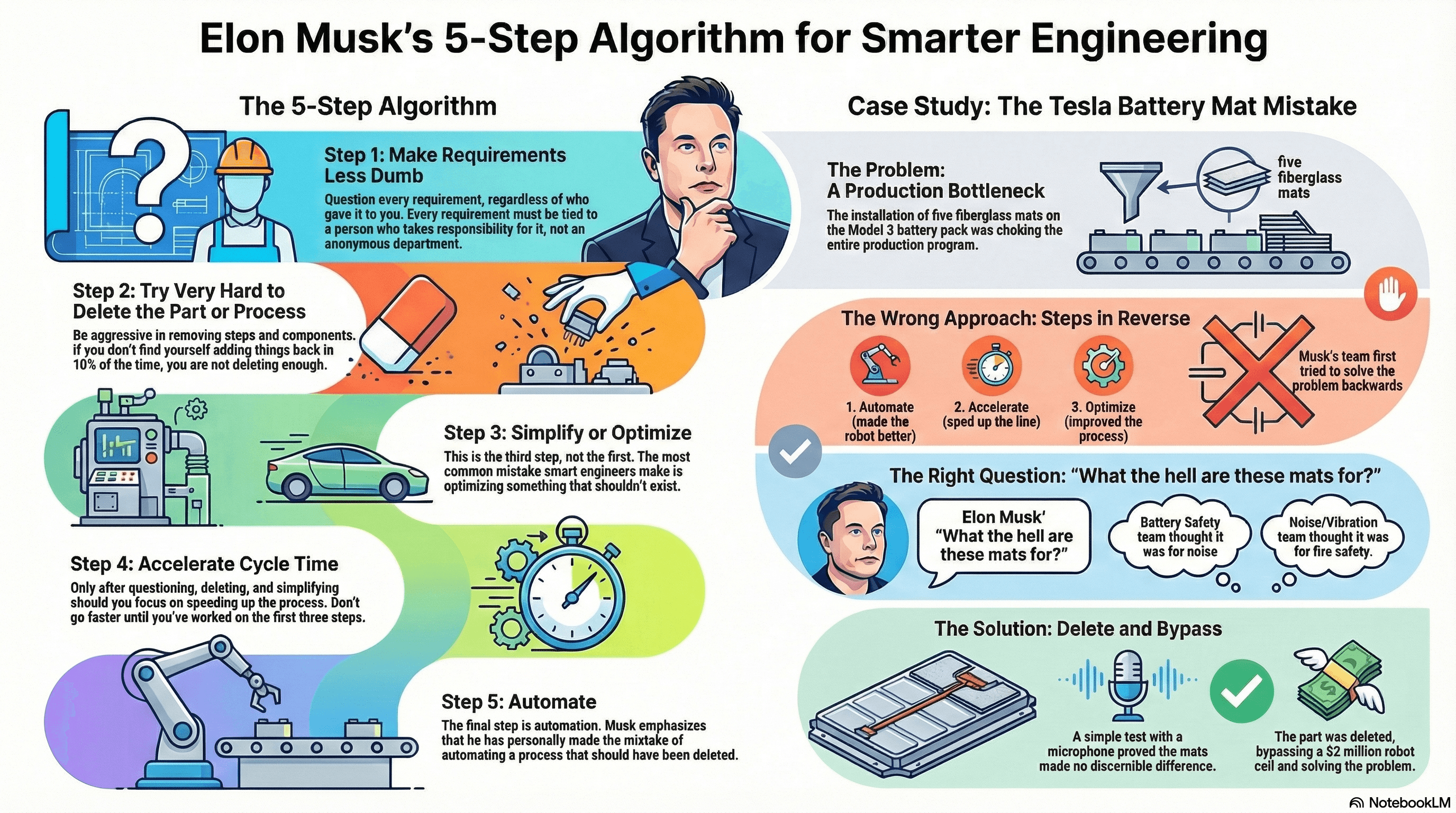
Elon Musk has introduced a transformative five-step algorithm aimed at revolutionizing engineering and problem-solving methodologies.
This approach emphasizes critical thinking and efficiency, challenging traditional practices.
Step 1: Question Every Requirement
Musk advocates for scrutinizing all requirements, regardless of their origin.
He asserts that even directives from intelligent individuals can be flawed, emphasizing the need to understand the purpose behind each requirement.
Step 2: Eliminate Unnecessary Components
After evaluating requirements, the next step is to remove any part or process that doesn't add value.
Musk suggests that if you're not occasionally adding elements back, you're not eliminating enough.
Step 3: Simplify and Optimize
Once unnecessary elements are removed, focus on simplifying and optimizing the remaining components.
Musk warns against optimizing parts that shouldn't exist in the first place, highlighting the importance of this step's sequence.
Step 4: Accelerate Cycle Time
With a streamlined process, the next objective is to speed up the cycle time.
However, Musk cautions against accelerating a flawed process, emphasizing the importance of addressing the previous steps first.
Step 5: Automate
The final step is automation.
Musk advises automating only after the process has been refined through the earlier steps, warning that automating inefficiencies can exacerbate problems.
Real-World Application: Tesla's Battery Production
A practical example of this algorithm in action is seen in Tesla's Model 3 battery production.
The production line faced a bottleneck due to the installation of five fiberglass mats on each battery pack.
Upon investigation, it was discovered that these mats served no significant purpose.
By eliminating them, Tesla bypassed the need for a $2 million robot cell, effectively resolving the bottleneck.
Implications for Broader Applications
Musk's five-step algorithm is not limited to engineering; it can be applied to various fields.
By questioning assumptions, eliminating unnecessary elements, and focusing on optimization before automation, individuals and organizations can enhance efficiency and innovation.
Embracing this approach encourages a shift from conventional problem-solving methods to a more thoughtful and streamlined process.
By adopting Musk's algorithm, we can challenge the status quo and drive meaningful improvements in our respective fields. |
0 Comments
Join the conversation
Be the first to comment
Share your thoughts above.